The guests' confinement in the studio
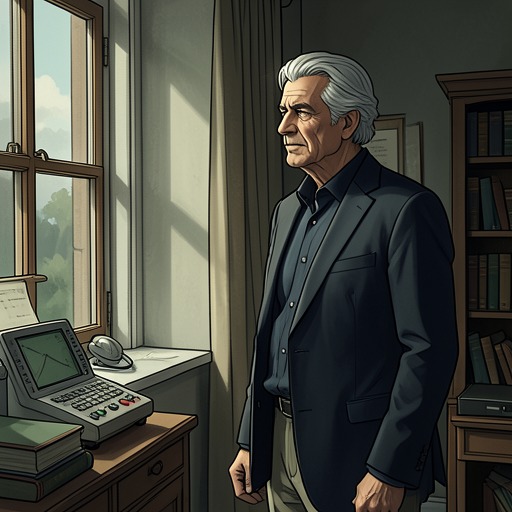
Nine Perfect StrangersThe guests’ confinement in the studio turns Tranquillum House’s promise of transformation into an immediate struggle for safety and agency. Locked inside while Masha’s recorded voice announces that the house is burning, the guests believe smoke and the sounds of fire signal mortal danger. They try to make the situation survivable, then discover that the fire is a looped recording and that the studio door has been unlocked for hours. Their escape depends not on completing Masha’s imposed test, but on questioning its premise and trying the handle.
From retreat to confinement
The confinement follows a program already organized around control of ordinary routines. Guests are told to answer a warning bell promptly for meals or smoothies, including during fast periods; room service is unavailable, though morning and late-evening smoothies are delivered. Masha has also instituted a period of silence for the retreat, expecting that guests will resist or break it and believing the quiet will set the right tone. These details establish a managed environment in which participants are asked to yield familiar choices. The later confinement pushes that management past the bounds of a wellness exercise: guests are no longer simply adjusting to rules but are left to believe they cannot leave a locked room.
Masha’s earlier experience with guests violating retreat rules helps explain the system she builds, though it does not justify the danger she later creates. When she first opened Tranquillum House, she was shocked to discover a family-sized meatlovers pizza being delivered at the back fence. She responds to guests’ workarounds by adding security cameras, monitoring, and bag checks, framing these precautions as being for their own good. The studio crisis makes that logic stark: surveillance and control, initially presented as safeguards for a retreat, become part of an environment where participants cannot be sure what is real or whether help will come.
A trial imposed as transformation
Inside the studio, the guests try to read the emergency through the ideas Masha has taught them. Lars urges the group to appear to cooperate with the madness, while Napoleon agrees that they should play along and seize the first chance to find a way out. The guests are divided between fear and a continuing effort to interpret what is happening as a designed exercise. Carmel says she had believed in Masha and in the promise of being transformed. Heather, by contrast, calls the situation pathetic. Their reactions mark a fracture between faith in the retreat’s program and the recognition that its leader may have become dangerous.
The guests’ uncertainty is made sharper by Masha’s earlier rationale for keeping them in another ordeal. She believes they must work their way out because the struggle is essential to their rebirth, like a baby squeezing through a birth canal. Yao and Delilah have begun to suggest letting the guests out or giving them a clue, but Masha insists they will work it out and dismisses the possibility that they are unable to understand her hints. In the studio, this philosophy has a concrete consequence: the guests’ distress is treated as useful material for a transformation Masha has defined on their behalf. The language of rebirth recasts confinement as a test, but it does not make the guests’ danger imaginary to them or establish their consent.
The apparent fire
The crisis escalates when the screen turns to static while Masha’s voice continues to address the guests. She tells them to detach from their assumptions and announces that her house is burning. Zoe says she can smell smoke; then Frances spots black wisps curling beneath the heavy oak door. Jessica screams for Masha to let them out. The screen goes black, and Masha’s sudden absence becomes frightening in its own right: the guests can no longer see the person directing the exercise, while smoke appears to enter the room.
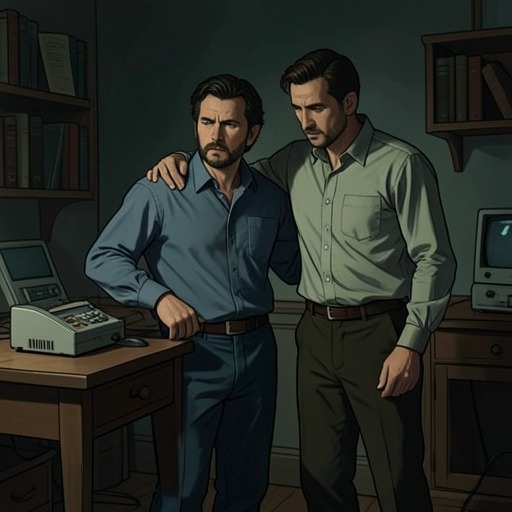
Tony calls for the doorway to be blocked. Heather and Napoleon quickly return from the bathrooms with dripping wet towels, roll them into tight cylinders, and wedge them along the floor of the door as the smoke increases. The action is practical and coordinated, in contrast with Masha’s language of detachment. The guests retreat to the point farthest from the door. Napoleon pulls Zoe close; she buries her face in his shirt, and he says the door does not feel hot, which he takes as a good sign. Carmel says she can hear the fire. The details sustain the guests’ conviction that the threat is physical, even as the room’s apparent emergency is being manufactured elsewhere.
Recognizing the loop
The turning point comes when Lars notices that a crash is exactly the same as one heard before. Jessica identifies a repeating sequence of crackling, rushing, a small bang, more crackling, and a huge bang. Tony concludes that the sound is on a loop, and Ben asks whether they are listening to a recording. The pattern gives the guests a way to test the apparent emergency rather than merely endure it. Frances still cannot reconcile that explanation with having seen smoke and imagined the fire so vividly; Heather insists that where there is smoke, there is fire. Their exchange preserves the force of the fear even after the sound has been explained.
Frances remembers Masha’s repeated lesson that nothing lasts forever and recalls an earlier exchange about a Russian doll: when Frances said there was no code inside, Masha answered, “Exactly.” She then asks when anyone last tried the doorhandle, distinguishing the physical handle from the keypad combinations Napoleon believes they have exhausted. The question shifts attention from solving the puzzle as Masha has presented it to checking the simplest means of exit. This is the decisive reversal: the guests have treated the room as sealed because they have been working through the codes, while the unlocked door has remained available to test.
Escape and consequence
On the security system, Yao sees the studio empty, with crumpled towels scattered across the floor, and asks how the guests escaped. Masha says they finally worked it out and that the door had been unlocked for hours. Her response confirms the gap between the ordeal as she designed it and the emergency as the guests experienced it. What she regards as a lesson they should discover has depended on them recognizing an overlooked exit while frightened by smoke, a locked door, and simulated fire.
The confinement’s central reversal is therefore both physical and interpretive. The guests first try to survive the apparent fire, then notice that its sounds repeat, and finally reconsider the door itself. The escape comes through observation and collective action, not through the promised wisdom of accepting Masha’s trial. In that contrast, the episode exposes the ethical limit of a transformation doctrine that treats other people’s fear as a necessary instrument: a therapeutic rationale cannot substitute for their informed agreement or make coercion safe.